
Nationwide RFID Deployment and Installation Services for Multi-Site Retailers
Retail RFID technology can improve item-level inventory visibility, accelerate cycle counts and replenishment, support omnichannel fulfillment, strengthen loss-prevention workflows, and enable new POS and self-checkout experiences.
TDX Tech helps retailers and RFID solution providers deploy the physical technology behind those applications with RFID hardware procurement, staging and configuration, site surveys, structured cabling, installation, testing, project management, logistics, and nationwide field services across the U.S. and Canada.
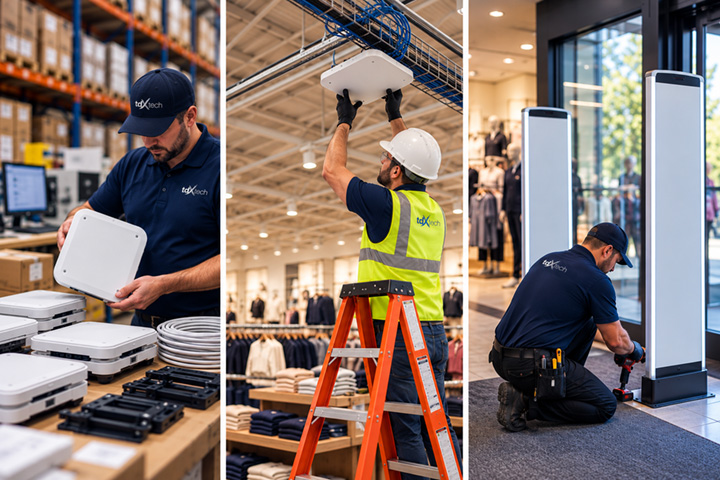
Retail RFID deployments are more than readers and tags.
At enterprise scale, the challenge is making sure the right RFID hardware, infrastructure, connectivity, installation standards, and field resources come together consistently at every store.
Retail RFID environments can include handheld readers, fixed readers, antennas, overhead readers, RFID portals, printers and encoders, POS and self-checkout hardware, mobile computers, network connectivity, structured cabling, mounting systems, and item-level RFID tags or labels.
Those technologies may be deployed across sales floors, stockrooms, store receiving areas, entrances and exits, checkout zones, BOPIS areas, and other store-level merchandise locations. TDX Tech coordinates the physical deployment lifecycle so hardware arrives prepared, sites are ready, installations follow defined standards, and completed work is documented and validated.
Common retail RFID deployment pressures
- RFID hardware and infrastructure requirements vary by store format and site conditions.
- Fixed readers and antennas require appropriate placement, mounting, power, network connectivity, cabling, and defined read zones.
- Handheld RFID readers and mobile computers must be configured, labeled, kitted, connected, and prepared for store workflows.
- POS, self-checkout, and basket-scanning applications may require coordinated integration of RFID readers, antennas, checkout hardware, networking, cabling, mounting, and testing.
- Existing LAN, Wi-Fi, power, cabling, and physical conditions may not support the planned RFID solution without remediation.
- Installations often must occur around store operating hours while minimizing disruption to associates and customers.
- Large programs require coordination among retailer IT, operations, loss prevention, RFID software providers, OEMs, VARs, facilities teams, logistics providers, and field technicians.
Why large retail RFID deployments become difficult
A successful pilot does not automatically translate into a successful rollout across hundreds or thousands of stores. At scale, site readiness, hardware logistics, installation consistency, testing, documentation, and exception management become critical.
One location may need additional network drops, another may have different mounting conditions, and another may require a revised antenna or reader position. Hardware availability, store access, construction activity, checkout configurations, and operational schedules can introduce additional variables.
Common pressures that slow RFID rollouts
Fragmented ownership: RFID hardware, networking, cabling, POS/SCO systems, logistics, site access, software, and field installation may be handled by different organizations working against different schedules.
Site-readiness issues: Missing network connectivity, inadequate cabling, power limitations, mounting conditions, or unexpected store layouts can prevent planned installations from being completed on the first visit.
Inconsistent field execution: Reader placement, antenna orientation, mounting, cabling, labeling, testing, photographs, and sign-off can vary when field resources are not following the same scope and acceptance standards.
Limited rollout visibility: Project teams need to know what has shipped, which stores are ready, which installations are complete, what exceptions remain, and whether each location has met defined acceptance criteria.
What makes TDX Tech’s retail RFID deployments different?
TDX Tech combines enterprise hardware services, centralized project management, staging and logistics, structured cabling, and nationwide field execution under one coordinated deployment model. Our disciplined project and field-service processes help support an industry-leading 97%+ first-visit success rate.
One partner for retail RFID hardware, staging, deployment, installation, and support
TDX Tech supports the physical technology lifecycle behind store-level RFID initiatives, from early site-readiness planning through nationwide rollout and ongoing field service.
RFID hardware and technologies we deploy in retail stores
Retail RFID solutions use different combinations of hardware depending on the merchandise, store environment, application, software platform, and level of automation required.
Handheld RFID Readers & Mobile Computers: Mobile RFID devices used by store associates for rapid cycle counts, inventory search, receiving, replenishment, exception management, and other item-level workflows. TDX Tech can procure, stage, configure, kit, deploy, activate, and support these devices across large store networks.
Fixed RFID Readers: Fixed readers provide automated RFID data capture at defined locations or read zones. TDX Tech supports mounting, network connectivity, power or PoE requirements, cabling, hardware placement, installation, and onsite validation.
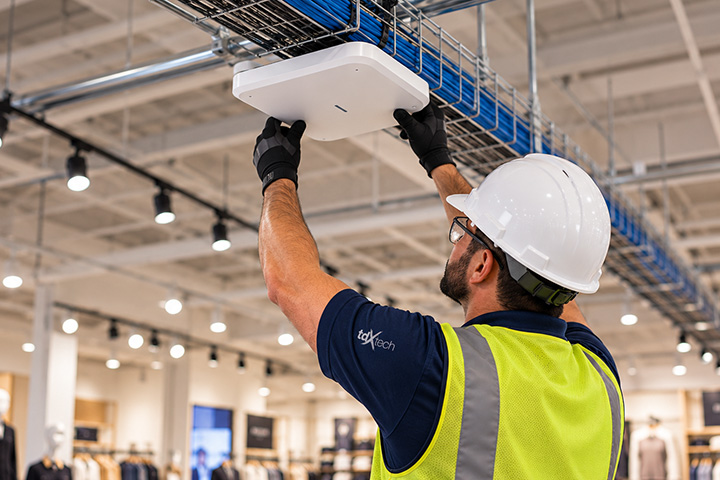
RFID Antennas & Overhead Readers: Antennas and overhead systems create defined read zones on sales floors, at stockrooms, entrances/exits, checkout areas, or other store locations. Deployment may require careful coordination of placement, orientation, cabling, reader location, power, and the surrounding environment.
RFID POS, Self-Checkout & Basket-Scanning Hardware: Readers and antennas can be integrated into POS counters, self-checkout kiosks, scanning areas, or other defined checkout zones to identify multiple tagged products without individually presenting each barcode to a scanner. TDX Tech supports the physical hardware, connectivity, mounting, cabling, installation, and field validation requirements.
RFID Portals & Transition-Point Readers: Portal and doorway systems can identify tagged merchandise moving through store receiving areas, stockrooms, entrances/exits, or other defined transition points. TDX Tech supports site surveys, mounting, cabling, connectivity, reader/antenna installation, and onsite testing.
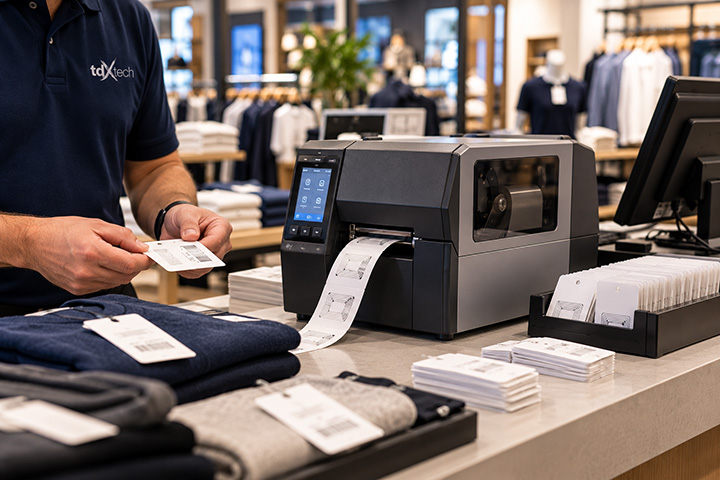
RFID Printers & Encoders: RFID printers encode RFID tags or labels while printing corresponding human-readable information and barcodes. TDX Tech can procure, stage, configure, deploy, connect, and validate store-level RFID printing hardware and peripherals.
Supporting Network & Store Infrastructure: RFID endpoints may depend on switches, PoE, LAN/Wi-Fi connectivity, structured cabling, mounting hardware, enclosures, POS/SCO equipment, and other store technologies. TDX Tech can coordinate these dependencies as part of the deployment scope.
RFID Tags & Labels: Passive UHF/RAIN RFID tags and labels are widely used for item-level retail applications. Tag selection, placement, encoding, and application are typically defined by the retailer and RFID solution provider; TDX Tech can coordinate the supporting hardware and deployment requirements.
Retail RFID pilots, refreshes, and nationwide rollouts
RFID programs typically begin with a limited pilot before expanding to additional store formats, regions, or the full retail footprint. TDX Tech can support pilot installations while helping establish repeatable field standards that can carry forward into larger deployment waves.
Pilots & proof-of-concept deployments: Support selected stores with site surveys, infrastructure preparation, hardware staging, installation, field documentation, and testing so project teams can evaluate physical deployment requirements before broader rollout.
New RFID rollouts: Coordinate procurement, staging, logistics, cabling, store scheduling, installation, validation, documentation, and exception management across regional or national store networks.
RFID refreshes & expansions: Replace or add readers, antennas, mobile devices, printers, checkout hardware, or supporting infrastructure as RFID programs expand or installed technology reaches refresh cycles.
Moves, adds, changes & break/fix: Provide onsite field services for hardware swaps, relocations, troubleshooting, cabling changes, replacements, and other post-deployment store requirements.
Retail RFID deployments across the U.S. and Canada
TDX Tech supports regional and nationwide RFID rollout and installation programs for multi-location retailers across North America.
Centralized project management, hardware procurement, staging, warehousing, logistics, structured cabling, and coordinated field services allow retailers and RFID solution providers to use one deployment partner across large store footprints.
North America
Comprehensive rollout coverage across the U.S. and Canada.
Multi-site Support
Our approach is optimized for dozens, hundreds, and even thousands of stores.
97%+ First-Visit Success
Disciplined project and field execution reduce visits, delays, and errors.
The TDX Tech retail RFID deployment process
Retail RFID rollouts become more predictable when hardware, infrastructure, logistics, field installation, testing, and project visibility are managed through one structured deployment process.
Deployment phase | Project Focus |
|---|---|
Rollout planning | Define stores, hardware, application requirements, installation standards, schedules, site-readiness criteria, testing requirements, stakeholders, documentation, and project milestones. |
Site surveys & readiness | Validate reader and antenna locations, POS/SCO conditions where applicable, mounting requirements, power, LAN/Wi-Fi connectivity, cabling pathways, store access, and other site-specific requirements. |
Hardware procurement coordination | Coordinate RFID readers, antennas, mobile computers, printers, mounting components, networking hardware, accessories, and related materials around availability and deployment schedules. |
Staging and configurations | Receive, inventory, configure, label, asset-track, test, kit, and prepare hardware by store or rollout wave before shipment. |
Structured cabling and infrastructure | Install or extend network drops, CAT6/fiber, PoE connectivity, and other low-voltage infrastructure required for fixed RFID endpoints and supporting technologies. |
Logistics & store delivery | Coordinate warehousing, inventory, location-specific kits, shipment timing, asset tracking, delivery schedules, and exceptions with installation milestones. |
Nationwide field deployments and installations | Schedule field technicians to install readers, antennas, portals, printers, mobile devices, POS/SCO-related RFID hardware, cabling, and other defined store infrastructure. |
Testing & validation | Verify connectivity and hardware operation, support read-zone or application validation according to project requirements, capture photographs and documentation, and complete site acceptance workflows. |
Project management and communication | Provide centralized oversight, stakeholder communication, schedule monitoring, WebTrax reporting, store-level documentation, issue escalation, and completion tracking. |
Validation and follow-through | Support hardware swaps, troubleshooting, moves/adds/changes, refreshes, de-installation, replacement logistics, and other post-deployment onsite requirements. |
Planning an RFID rollout project for your stores?
Complete the form below to inquire about our comprehensive retail RFID technology rollout services and related technologies.
If you would like immediate assistance, please call TDX Tech at 888-777-0532.
OUR PROJECT TEAMS
Our dedicated project managers have been partnering with IT and project teams for 45+ years – we ensure that your technology deployments and installations succeed.
NATIONAL IT SUPPORT
Need far-reaching IT deployments, IT installations, or IT field services? We provide technology services and support across North America, including the US, Canada, and more.
View our coverage map »
45+ YEARS OF EXPERTISE
Since 1981, TDX Tech has provided technology lifecycle solutions to businesses throughout the world, including hardware solutions, field services, and depot maintenance programs.
REASONS TO PARTNER
Finding the right technology partner can be a daunting task. We’ve compiled our Top 5 Reasons why Enterprises Partner with TDX Tech to help their technology and project teams Do IT Smarter.™



Retail RFID FAQs
RFID, or Radio Frequency Identification, is a wireless technology that uses RFID tags, readers, and antennas to identify and track tagged merchandise without requiring direct line-of-sight barcode scanning.
Retail applications include item-level inventory management, cycle counting, replenishment, product search, store receiving, omnichannel fulfillment, POS and self-checkout, and loss prevention.
Item-level RFID assigns a unique RFID identifier to an individual merchandise item. This allows compatible systems to distinguish individual physical items even when multiple products share the same SKU or UPC, supporting more granular store-level inventory visibility and merchandise workflows.
Passive UHF RFID, commonly associated with RAIN RFID, is widely used for item-level retail applications. Passive tags do not require their own battery and can be read wirelessly by compatible RFID readers and antennas.
A retail RFID environment may include RFID tags or labels, handheld readers, fixed readers, antennas, overhead readers, portals, RFID printers and encoders, RFID-enabled mobile computers, POS or self-checkout hardware, network connectivity, structured cabling, and software that processes RFID data.
Retail RFID solutions can incorporate technologies from leading providers including Avery Dennison, GreyOrange, Impinj, Keonn, Nedap, PervasID, Sensormatic Solutions, SML Group, and Zebra Technologies.
Depending on the application, retail RFID systems may include RFID tags and labels, handheld and fixed readers, antennas, overhead readers, RFID portals, printers and encoders, loss-prevention technology, and RFID-enabled POS and self-checkout hardware.
TDX Tech provides the physical deployment services required to implement RFID technologies across retail environments, including hardware procurement and staging, site surveys, structured cabling and network infrastructure, equipment installation, configuration, testing and validation, rollout project management, and nationwide field services.
NOTE: Technology providers listed are representative of the retail RFID ecosystem and do not necessarily indicate a formal partnership, certification, or prior TDX Tech deployment.
Retailers use RFID for a range of store-level applications, including item-level inventory management, cycle counting, stockroom and sales-floor inventory visibility, replenishment, product location, loss prevention, POS and self-checkout, basket scanning, and omnichannel fulfillment such as BOPIS and ship-from-store.
RFID can help retailers maintain more accurate inventory data, locate merchandise faster, streamline checkout, improve product availability, and support more efficient store operations.
RFID readers identify tagged merchandise and provide item-level data to retail inventory applications. Retailers can use this information to conduct faster cycle counts, locate merchandise, improve inventory visibility, replenish the sales floor, support store receiving, and improve BOPIS or ship-from-store workflows.
In an RFID-enabled self-checkout system, compatible readers and antennas create a defined read zone that can identify multiple tagged products without requiring the shopper to scan each barcode individually.
The RFID platform and POS application then use those item identities as part of the checkout workflow.
RFID basket scanning uses a defined RFID read zone to identify multiple tagged items placed within a basket or checkout area.
Depending on the solution, the physical deployment can include readers, antennas, checkout hardware, mounting components, power, network connectivity, cabling, configuration, and onsite testing.
Depending on the application, fixed RFID equipment may be installed at store receiving areas, stockrooms, doorways, entrances and exits, ceilings, sales-floor zones, checkout areas, self-checkout stations, or other defined merchandise read zones.
An RFID installation can include site surveys, power and network readiness, structured cabling, reader and antenna mounting, device installation, connectivity, configuration support, read-zone validation, hardware testing, photographs, documentation, and store-level acceptance.
Yes. TDX Tech supports retail RFID deployment and installation programs across the U.S. and Canada with centralized project management, hardware procurement, staging, logistics, site surveys, structured cabling, field installation, testing, documentation, and ongoing field services.
Yes. TDX Tech specializes in multi-site technology deployments and can coordinate hardware, staging, logistics, site readiness, technicians, installations, documentation, exceptions, and completion milestones across large retail store networks.
Yes. TDX Tech can procure project-defined RFID and supporting hardware, then receive, inventory, configure, label, asset-track, kit, test, warehouse, and ship equipment according to store and deployment schedule.
It can. Fixed RFID readers, antennas, checkout systems, and other endpoints may require network drops, PoE, CAT6/fiber cabling, LAN connectivity, or related low-voltage infrastructure. TDX Tech can incorporate those requirements into the store deployment scope.
Planning a retail RFID pilot, rollout, or refresh?
If your team is coordinating RFID hardware, store infrastructure, staging, logistics, cabling, checkout technology, site readiness, and field installation across multiple retail locations, TDX Tech can help simplify the deployment model and provide one point of accountability from hardware preparation through field execution.
Use our form to start a conversation about your RFID application, store footprint, hardware requirements, deployment scope, and timeline.